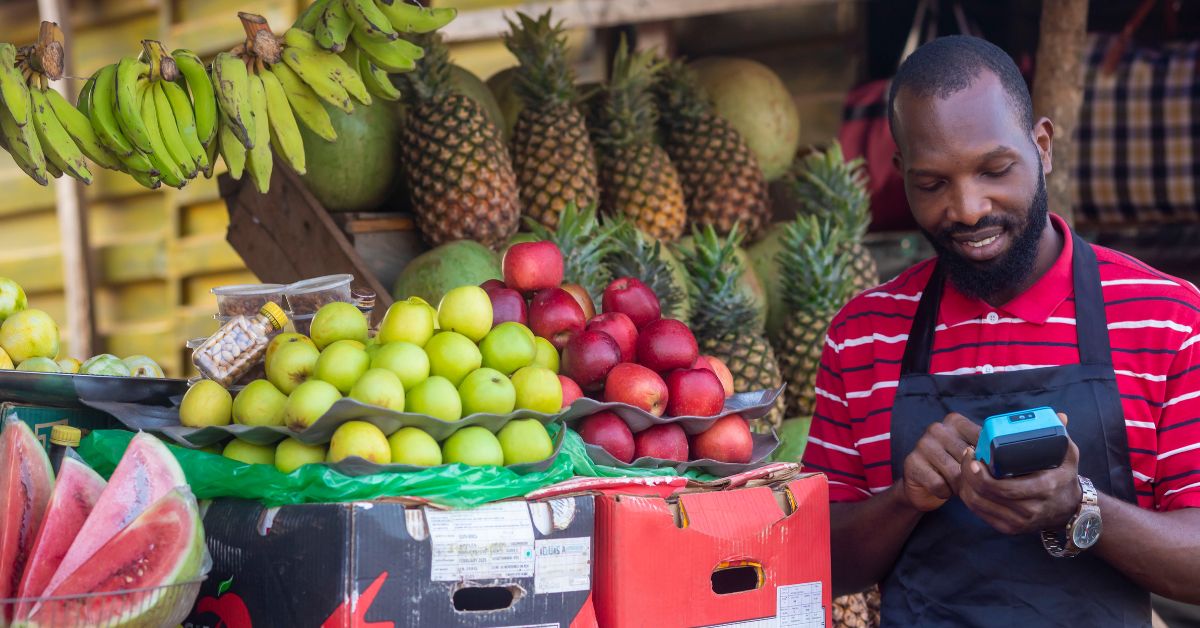
Africa processed roughly $1.4 trillion through mobile money in 2025—about two-thirds of global transaction value—according to GSMA data. East Africa alone moved more than $800 billion. What began as a workaround for people without bank accounts has become everyday economic infrastructure: wages, merchant payments, utility bills, government transfers, and savings all flow through the same rails.
The original genius was simplicity. A SIM card, a basic handset, and an agent network that is now denser than bank branches in many markets. M-Pesa in Kenya proved the model; MTN MoMo, Airtel Money, and others scaled it. In several West African markets, the majority of transactions still run over USSD because it works on feature phones and needs no data. Agent density—hundreds of thousands of outlets—made cash-in and cash-out practical.
That national success, however, stopped at the border. Most intra-African trade and remittances still route through correspondent banks in dollars or euros, adding cost and delay. The Pan-African Payment and Settlement System, developed by Afreximbank with the African Union and AfCFTA Secretariat, is the deliberate attempt to change that. By late 2026 it operated in more than 30 countries, connecting over 200 commercial banks and payment providers plus national switches. Transaction volumes rose roughly 1,000 percent year-on-year in measured periods, with cost reductions of 90 percent or more versus traditional routes and settlement often measured in seconds rather than days.
Pilots linking mobile wallets to PAPSS—such as the Nigeria-Ghana corridor—are beginning to connect the continent’s two dominant payment worlds: bank-led and mobile-led. Ethiopia’s non-bank mobile-money operators are preparing to plug in. The system’s value is not just speed; it keeps settlement in local currencies and reduces the foreign-exchange burden on banks.
Challenges remain. Currency volatility, regulatory differences, and the sheer work of getting businesses and consumers to switch channels mean adoption is still uneven. Mobile-money platforms themselves face limits: USSD was never designed for the volumes and security demands now placed on it. Instant payment systems are proliferating—dozens are live—but full interoperability across banks, telcos, and borders is unfinished.
When the pieces connect, the economic effect compounds. Lower payment costs support the AfCFTA’s trade ambitions. Governments can disburse transfers faster and with less leakage. Small traders can settle next door without losing a large share of value to intermediaries. The rails are no longer theoretical. The question is how quickly the continent moves from connected infrastructure to routine, high-volume use.